TL;DR — The 19.3 Hz Mystery in 30 Seconds
19.3 Hz is infrasound — below the ~20 Hz limit of human hearing, felt by the body rather than heard. Ancient structures from Stonehenge to Malta's Hypogeum show measurable acoustic tuning, and Sardinia's Nuragic towers fit that pattern. The science of resonance is real; the specific 19.3 Hz tone is the fictional engine of The Mystery of the Stone Tower.
"19.3 hertz. This is the frequency at which the Earth's crust resonates. It falls below the threshold of human hearing — but it can be perceived by the resonant structures of human internal organs."
These words appear in the first chapter of The Mystery of the Stone Tower, spoken by the novel's protagonist, acoustic archaeologist Leo Marchi, as he analyses a tone that has no business existing. The 19.3 Hz frequency is the novel's central scientific mystery — but the science behind it is real.
In Short / Key Takeaway
In short: the human body resonates between 4 and 30 Hz, ancient builders may have tuned chambers for ritual sound, and infrasound research in archaeology is real and growing. 19.3 Hz is fiction grounded in physics — a frequency the Earth could whisper at, if it wanted to be heard.
What Is 19.3 Hz?
Nineteen point three hertz is an infrasound frequency — a vibration so low that the human ear cannot detect it. The threshold of human hearing is approximately 20 Hz. Everything below that is infrasound: sound that passes through the body without reaching the ears.
But "cannot hear" does not mean "cannot feel." The human body has its own resonant frequencies:
| Body Part | Resonant Range | Effect at Match |
|---|---|---|
| Abdominal organs | 4–8 Hz | Deep visceral vibration, nausea |
| Chest cavity | 5–8 Hz | Breathing pressure, unease |
| Head / skull | 20–30 Hz | Pressure behind the eyes, disorientation |
| Whole body (standing) | ~5–10 Hz | Balance disturbance |
When external vibration matches these frequencies, the body vibrates in sympathy — a phenomenon called mechanical resonance. At 19.3 Hz, the vibration enters through the soles of the feet, travels up through the bones of the legs and spine, and settles in the cavities of the chest and skull. The sound is not heard. It is inhaled.
Real Research: Infrasound in Ancient Structures
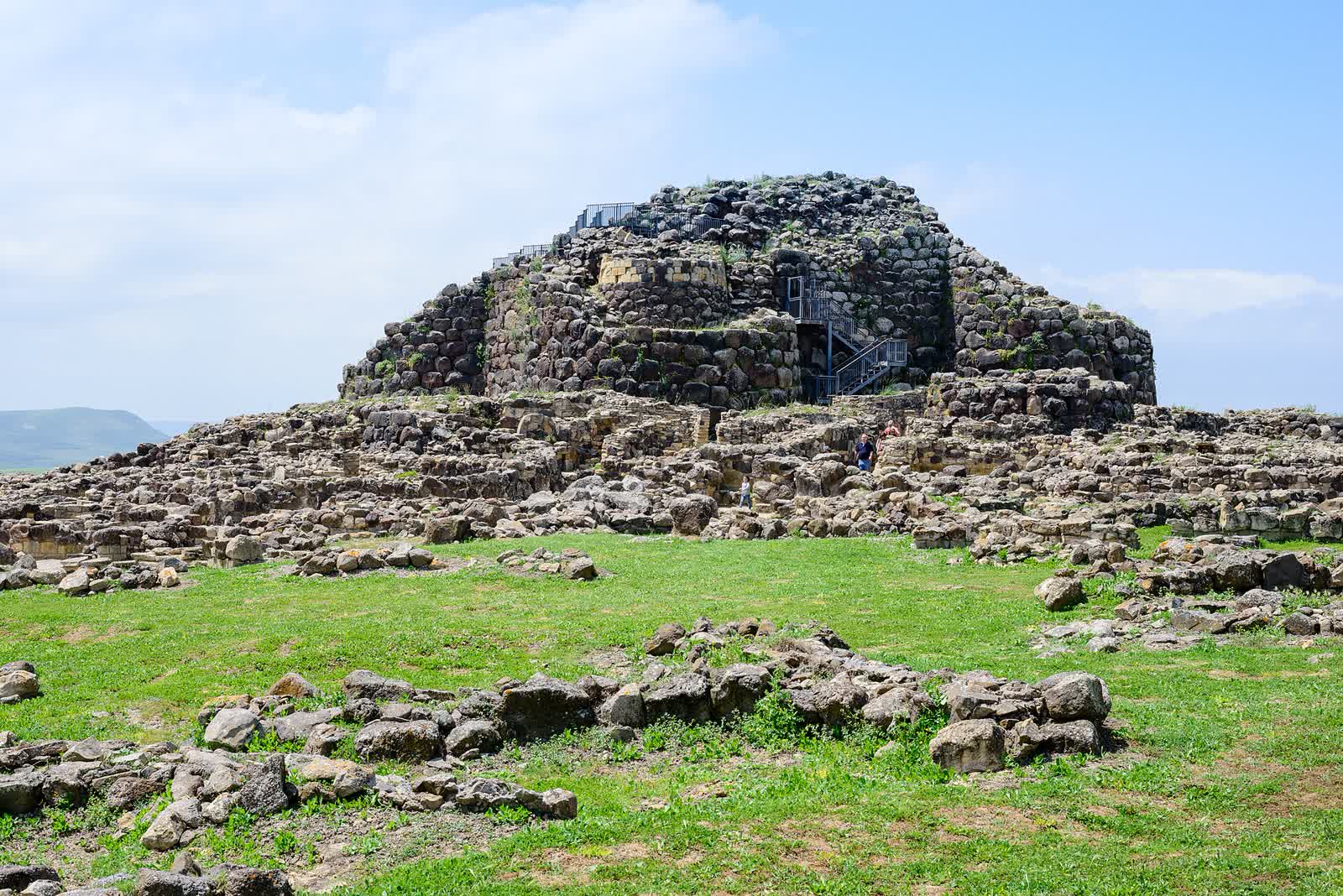
In 2006, Italian acoustic physicist Giovanni Latronico measured anomalous acoustic signals inside Nuragic structures on Sardinia. The frequencies he documented fell within the infrasound range — below 20 Hz. His measurements suggested that the internal chambers of these Bronze Age towers were not randomly shaped. They were tuned.
This is not an isolated finding. Archaeoacoustics — the study of sound in ancient places — has documented similar phenomena across the world:
- Stonehenge, UK: Acoustic measurements by Rupert Till documented resonance peaks at approximately 110 Hz within the stone circle, suggesting the site was designed for ritual music or speech.
- Hal Saflieni Hypogeum, Malta: This subterranean Neolithic temple has an "Oracle Chamber" that amplifies male voices at specific frequencies. The chamber's carved niches produce a resonant frequency of approximately 110 Hz — the same range as the human voice.
- Newgrange, Ireland: The 5,200-year-old passage tomb has acoustic properties that concentrate sound waves at the rear of the chamber, potentially creating a "speaking" effect for anyone standing at the entrance.
- Mayan ball courts, Central America: Designed to produce specific acoustic effects — the sound of a bouncing ball amplified to mimic the roar of the feathered serpent god.
🧿 The Schumann Resonance
First predicted by physicist Winfried Otto Schumann in 1952, the Schumann Resonance is the global electromagnetic resonance between the Earth's surface and the ionosphere. Its fundamental frequency is approximately 7.83 Hz. This is a real, measurable phenomenon — not a fictional device. Some researchers have proposed a link between the Schumann Resonance and human brainwave patterns (alpha waves centre around 8–12 Hz), though this remains a topic of ongoing investigation.
The 19.3 Hz frequency in The Mystery of the Stone Tower is a fictional frequency — but it sits within a real physical framework where the Earth itself generates frequencies that influence the human body.
The Body as a Receiver
NASA's aerospace medicine research in the 1970s documented the physiological effects of prolonged low-frequency vibration on astronauts. The findings included nausea, vertigo, cardiac arrhythmia, and disorientation. These effects were caused by the mechanical resonance of internal organs — the same mechanism that makes infrasound perceptible.
In the novel, the shepherd Gianni experiences this directly. When he touches the spiral grooves of the newly exposed tower, the 19.3 Hz vibration enters his body through his hands and feet, bypassing his ears entirely. The tower speaks to him in a voice that is not sound but sensation — a voice that travels through bone and tissue directly to the centres of memory and emotion. The science behind this is not supernatural. It is physics. But as Leo Marchi writes in his paper: "Physics, on its own, is enough to make a shepherd believe in ghosts."
Why Would Ancient Builders Design for Sound?
This is the question that drives the research in The Mystery of the Stone Tower — and it is a question that real archaeologists are asking. If the Nuragic civilization of Sardinia built 7,000 towers across the island, and if those towers were designed to produce specific acoustic effects, what was the purpose?
One hypothesis is ritual. Sound — particularly low-frequency sound — has been used in spiritual practices across cultures for millennia. Tibetan singing bowls, Gregorian chant, Aboriginal didgeridoo, the Sardinian Tenores polyphonic singing — all produce frequencies that affect the human body and consciousness. The Nuragic towers may have been designed as acoustic instruments for ceremonial use.
Another hypothesis is communication. A network of towers, each tuned to a specific frequency, could transmit signals across the island. The interiors of nuraghi are remarkably quiet — the thick stone walls block external noise, creating a chamber where even a whisper carries. If a speaker stood in the right position, their voice could be amplified by the chamber's resonance and projected outward.
A third hypothesis — the one explored in the novel — is that the towers were designed as a form of acoustic memory. That the spiral grooves carved into the stone, the precise dimensions of the chambers, the alignment of the openings to celestial events — all of these were not architecture but inscription. A language written in stone and read through vibration.
📖 The Science Behind the Fiction
In The Mystery of the Stone Tower, the 19.3 Hz frequency is presented as a real measurement — within the novel, a clean tone recorded by a seismological station on the Orgosolo massif. The protagonist, Leo Marchi, drives north to investigate and finds a tower that has been buried for 4,000 years, its walls engraved with spiral grooves that are still warm to the touch. The tone is not an anomaly. It is an invitation. The novel explores what happens when a scientist follows the evidence where it leads — even when the evidence leads to conclusions that sound like fiction. (The real-world seed: the researchers Latronico et al., 2006, reported unexplained low-frequency signals near Gola su Gorropu — not at 19.3 Hz.)
→ Experience the 19.3 Hz frequency on the interactive simulator
What We Still Don't Know
The Nuragic civilization left no written records. They built 7,000 stone towers across Sardinia between 1900 and 700 BCE, and then they vanished — not through conquest or collapse, but through gradual assimilation. The Romans arrived, the Phoenicians arrived, the Carthaginians arrived, and the Nuragic people simply... became someone else. Their towers remained. Their purpose did not.
Archaeoacoustics is a young field. The measurements are difficult to replicate, the funding is scarce, and the academic establishment remains sceptical. But the data is accumulating. Chamber by chamber, frequency by frequency, a picture is emerging of a civilization that understood sound in ways we are only beginning to rediscover.
The 19.3 Hz frequency in The Mystery of the Stone Tower is a work of fiction. But the principle behind it — that ancient builders shaped stone to shape sound, and that sound shapes the human body — is not. The towers are real. The island is real. And the mystery is still waiting for someone to solve it.
FAQ — The 19.3 Hz Frequency
What is 19.3 Hz?
19.3 hertz is an infrasound frequency — a vibration below the ~20 Hz threshold of human hearing. It cannot be heard but can be felt through mechanical resonance in the human body.
Is the 19.3 Hz frequency real?
Infrasound inside ancient structures is well documented, and a 19.3 Hz harmonic sits within a real physical framework (the Schumann Resonance is about 7.83 Hz). In The Mystery of the Stone Tower, the specific 19.3 Hz tone is a fictional device built on this real science.
What is archaeoacoustics?
Archaeoacoustics is the study of sound in ancient places. Researchers have documented resonance in Stonehenge, the Hal Saflieni Hypogeum, Newgrange and Mayan ball courts that suggests structures were designed for sound.
What is the Schumann Resonance?
Predicted by physicist Winfried Otto Schumann in 1952, it is the global electromagnetic resonance between the Earth's surface and the ionosphere, with a fundamental frequency of about 7.83 Hz.
Why would ancient builders design structures for sound?
Low-frequency sound has been used in ritual across cultures — Tibetan singing bowls, Gregorian chant and the Sardinian Tenores. Towers may have served as acoustic instruments for ritual, communication, or in the novel, a form of acoustic memory.
Sources & Further Reading
- W.O. Schumann (1952), on the global electromagnetic resonance later named the Schumann Resonance (fundamental ≈7.83 Hz).
- Rupert Till et al., acoustic studies of Stonehenge demonstrating resonance peaks around 110 Hz within the stone circle.
- Hal Saflieni Hypogeum (Malta), "Oracle Chamber" resonance documented at approximately 110 Hz.
- NASA aerospace medicine research (1970s) on physiological effects of prolonged low-frequency vibration.
- Giovanni Latronico (2006), anomalous infrasound measurements inside Nuragic structures on Sardinia, as referenced in MAREVA series research notes.
Hear It for Yourself
Visit the interactive 19.3 Hz frequency simulator — experience the vibration that drives the mystery.
Experience 19.3 Hz