Su Nuraxi di Barumini: A Field Guide to Sardinia's Most Famous Stone Tower
In Short
Su Nuraxi is the only Nuraghe complex UNESCO has ever inscribed (World Heritage No. 833, 1997), and the only one where you can read a full 3,000-year story in a single glance: an ~18 m tower raised around 1500 BCE, a four-apsed addition, a village that grew around it for a millennium, and Punic and Roman layers stacked on top. Visit with a guided tour, half a day, and the Marmilla plain's golden light in late afternoon. Prices and hours shift seasonally — check the official site before you go (information as of September 2026).
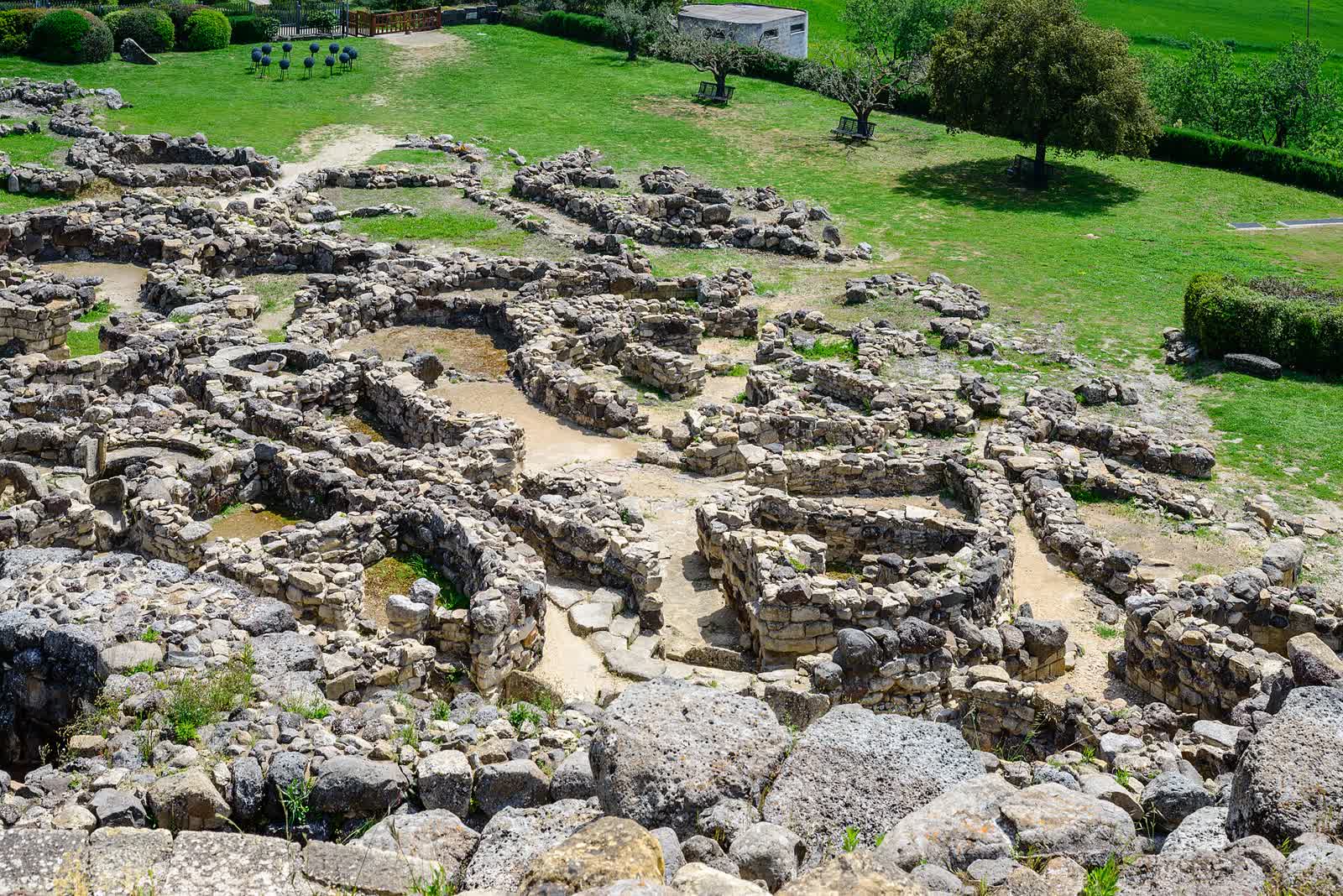
What exactly am I looking at?
Five things, built across three thousand years, in one field:
- The central tower — the oldest part, raised around 1500 BCE from basalt blocks: a truncated cone, roughly 18 metres tall as it stands today (originally taller, the summit ring lost), with a corbelled dome over the ground-floor chamber.
- Four bastions — added around 1300 BCE, connected by curtain walls with occupied chambers inside, turning the tower into a fortress.
- The village — huts with circular walls and apsidal (keyhole-shaped) interiors, courtyards, a meeting hut larger than the rest. Built and rebuilt between the 13th and 6th centuries BCE, home to perhaps several hundred people.
- The Punic and Roman layers — the site was not abandoned when the towers fell out of use: sanctuaries, houses and a square tower were added under Carthaginian and Roman rule.
- The finds — the famous bronze model of a Nuraghe (a tower-within-a-tower votive), tools, weapons and everyday objects, most now in the Antiquarium below the site or in Cagliari's archaeological museum.
Why is it the famous one?
Because of what the excavations proved. Between 1950 and 1956, the archaeologist Lilliu led the digs that untangled the stratigraphy — tower first, then bastions, then village, then Punic and Roman overlays — and in doing so turned Su Nuraxi into the reference sequence for the entire Nuragic civilization. Every other site on the island is dated by comparison to this one. UNESCO inscribed it in 1997 as "the most impressive of all the nuraghi" — a rare case where the designation and the experience agree.
How do I get there?
| From | By | Roughly |
|---|---|---|
| Cagliari | Car (SS131 north, then SP11 to Barumini) | ~60–70 km, about an hour |
| Oristano | Car (SS131 south) | ~65 km, about an hour |
| Cagliari | Bus via Sanluri | 2+ hours each way; thin schedules — driving is the practical choice |
| Olbia / Costa Smeralda | Car | 2.5–3 hours — pair it with an overnight in the Marmilla or Barbagie |
The site sits at the edge of Barumini (province of South Sardinia), on a low basalt ridge in the Marmilla — the island's grain-basket plain, a landscape of wheat fields, cork oaks and sudden stone outcrops. The medieval village of Barumini and the Girola castle with its gardens are a ten-minute walk uphill from the ticket office.
Tickets, tours and timing
- Entry is by guided tour only, in groups, with timed tickets. In high season, book ahead — groups fill.
- Allow 2–3 hours: the guided circuit (about an hour to ninety minutes) plus the Antiquarium and the village of Barumini itself.
- Best light is late afternoon, when the basalt turns gold and the crowds thin. Summer midday is exposed and hot; there is little shade on the circuit.
- Prices have sat in the €12–15 band for the full site, with reductions for children and groups. Verify current prices and opening hours on the official Fondazione Barumini Sistema Cultura pages before travelling (information as of September 2026).
What should I notice that most visitors miss?
- The masonry change. The original tower is tight basalt polygonal work; the bastions are coarser; the village is fieldstone and clay. Three builders, seven centuries apart, in one glance.
- The spiral stair. Inside the curtain wall you can see the passage that climbed toward the upper storeys — the kind of single-file helix that a novel might call "narrow enough for one person."
- The meeting hut. Larger, with stone benches around an apse — the clearest evidence of collective decision-making in a civilization that left no written records.
- The sound. Inside the ground chamber, voices drop and low frequencies seem to thicken. Mainstream archaeology does not claim the towers were "built for acoustics" — but stand in that chamber and you will understand why the hypothesis refuses to die.
The fiction question, answered honestly
In The Mystery of the Stone Tower, Book One of The Whisper of the Nuraghi, a frequency — 19.3 Hz — is recorded beneath a collapsed hillside, and a tower begins to sing. That frequency is a fictional device. The physics it leans on is real: infrasound below human hearing affects the body, and acoustic archaeology is a live, contested field (the 2006 report by Latronico and colleagues of unexplained low-frequency signals in the limestone of Gola su Gorropu is one of its genuine puzzles). Su Nuraxi itself is real, visitable, and needs no embellishment. The towers, the village, the bronze votive, the golden light — the island supplies all of it. The singing is mine.
Pair it with
- Nuraghe Santa Anastasia — a few kilometres away, free to walk around, a perfect "second course" after the guided tour.
- The Sanluri castle and its wheat-museum on the drive back toward Cagliari.
- Our free Archaeological Map of Sardinia — 20+ sites including Su Nuraxi, with itineraries and the novel's connections to each.