TL;DR — The Nuragic Civilization in 30 Seconds
The Nuragic people of Bronze Age Sardinia (~1900–700 BCE) built about 7,000 stone towers — more ancient stone monuments on one island than medieval castles in all of Europe — plus giants' tombs, sacred wells and megaron temples. They left no written records, their purpose is still debated, and a possible answer lies deep in the field of archaeoacoustics. In short: Sardinia holds the Mediterranean's greatest unsolved ancient mystery.
"Seven thousand towers, scattered across the island like the bones of a forgotten civilization. They were already ancient when Rome was founded. And no one knows why."
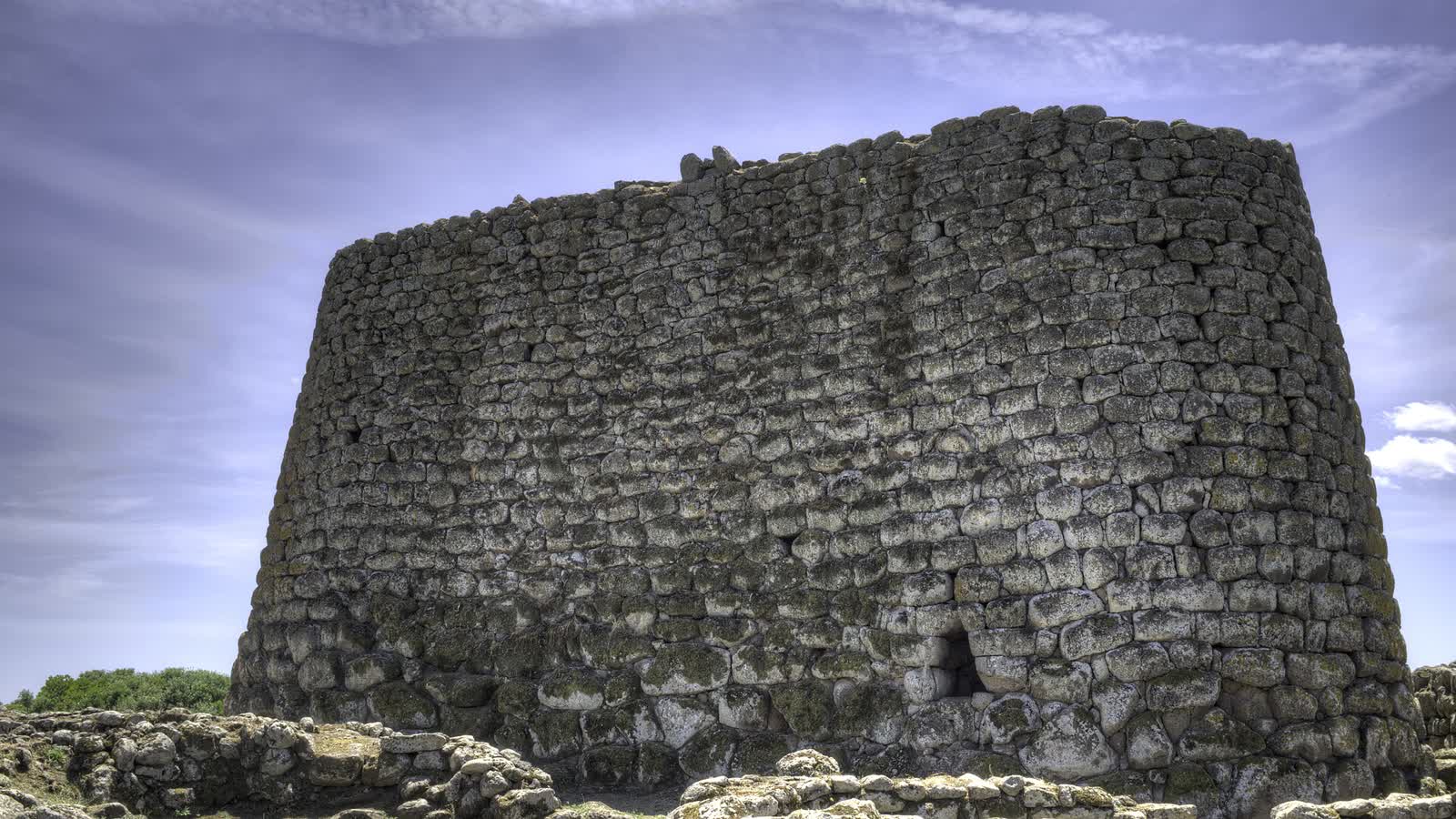
This is the opening mystery of The Mystery of the Stone Tower — but it is also the opening mystery of Sardinia itself. The island of Sardinia, the second-largest in the Mediterranean, is home to approximately 7,000 Nuraghe towers. To put that number in perspective: there are more Bronze Age stone towers on this single island than there are medieval castles in all of Europe. They were built between 1900 and 700 BCE, a span of 1,200 years. They were built by a civilization that left no written records. And when that civilization vanished, its towers remained — standing, silent, waiting.
Who Were the Nuragic People?
The Nuragic civilization emerged on Sardinia around the 18th century BCE, during the middle Bronze Age. They were not newcomers to the island — archaeological evidence shows human habitation on Sardinia dating back to the Paleolithic. But something changed around 1900 BCE. The population began building towers. Not just a few towers, but thousands of them, in every corner of the island.
They were master stonemasons. The Nuraghe towers were built using a technique called corbelling — each course of stone projects slightly inward until the walls meet at the top in a false dome (tholos). The blocks were fitted together without mortar, held in place by gravity alone. This technique requires extraordinary precision: if any single stone is out of place, the entire structure collapses. The towers are still standing after 3,500 years. That is not luck. That is engineering.
⏳ Timeline
1900–1600 BCEEarly Nuragic: First single-tower nuraghi appear. The Bonnanaro culture transitions into the Nuragic Bronze Age.
1600–1200 BCEMiddle Nuragic: The "classic" period. Complex multi-tower nuraghi built. Peak of the civilization. Extensive trade with Mycenaean Greece and Cyprus.
1200–900 BCELate Nuragic: "Giants' Tombs" and sacred wells constructed. The "Sea Peoples" period — possible connections to the Sherden warriors.
900–700 BCEFinal Nuragic: Phoenician contact begins. Many nuraghi abandoned. The civilization gradually fades.
What They Built
The Nuragic people built more than just towers. Their architectural legacy includes:
The Nuraghe (Towers): The signature structure. Simple nuraghi are single truncated cones, 10–20 metres tall, with internal chambers connected by spiral staircases. Complex nuraghi (like Su Nuraxi at Barumini) consist of a central tower surrounded by multiple subsidiary towers, enclosed by a curtain wall, forming a triangular or pentagonal bastion. The most complex, Nuraghe Arrubiu at Orroli, has five towers and a central keep.
The Giants' Tombs (Tombe dei Giganti): Monumental collective burial tombs, shaped like a bull's head. The largest is over 30 metres long. They were used for communal burial over centuries, containing the remains of hundreds of individuals.
The Sacred Wells (Pozzi Sacri): Underground water temples with trapezoidal staircases descending to a circular chamber over a spring. The most famous, Santa Cristina at Paulilatino, has a perfectly preserved tholos ceiling and is aligned to the equinox sunrise.
The Megaron Temples: Rectangular buildings with a central hearth, similar to early Greek temple forms. Their presence suggests cultural exchange with the Aegean world.
The Nuragic Legacy — At a Glance
| Structure | What It Is | Where to See It |
|---|---|---|
| Nuraghe (tower) | Truncated-cone stone tower, corbelled false dome | Su Nuraxi, Arrubiu, Santu Antine |
| Giants' tombs | Collective burial monument shaped like a bull's head | Coddu Vecchiu, Li Lolghi |
| Sacred wells | Underground water temple, spring + tholos chamber | Santa Cristina, Santa Vittoria |
| Megaron temples | Rectangular building with central hearth | Malchittu, Fuata |
The Mystery of the 7,000 Towers
The central question of Nuragic archaeology is also the simplest: why? Why did a Bronze Age civilization build 7,000 stone towers on a single island? The classic interpretation — defensive fortresses — does not hold up. Many nuraghi are in remote locations with no strategic value. Some are built on valley floors, easily surrounded. Many have no defensive features at all — no arrow slits, no battlements, no moats. If they were fortresses, they were the worst fortresses ever built.
The grain storage theory (nuraghi as "granaries") is equally problematic. The interiors are not designed for bulk storage. The damp basalt walls would ruin grain within weeks. The chambers are often too small for significant quantities. And why build 7,000 granaries for an island population that never exceeded 300,000?
Recent research in archaeoacoustics suggests a third possibility: the towers were designed as acoustic instruments. The internal chambers produce measurable resonance patterns. The corbelled vaults amplify certain frequencies. The spiral corridors channel sound in specific ways. The Nuragic people may have built not for defence or storage, but for sound.
What Happened to Them?
The Nuragic civilization did not collapse. It did not fall to invasion. It did not experience a catastrophe. It simply... diffused. The Phoenicians arrived around 800 BCE and established trading posts on the coast. The Carthaginians arrived in the 6th century BCE and pushed inland. The Romans arrived in 238 BCE and incorporated Sardinia into the empire. Each wave of newcomers brought new languages, new gods, new ways of life. The Nuragic people absorbed them, adapted, and gradually became something else.
By the time the Roman Republic began its rise, the Nuragic civilization had been gone for centuries. The towers remained — incorporated into Roman villas, used as quarries for churches, adopted as shelters by shepherds. Their original purpose was lost. The people who built them had become the people who forgot them.
That is the real mystery. Not that the towers were built, but that their builders left no explanation. No inscriptions. No texts. No Rosetta Stone. Seven thousand stone messages from a civilization that chose to speak in stone rather than in words. And we are still learning to read them.
📖 In The Mystery of the Stone Tower
The novel explores this mystery through the eyes of Leo Marchi, an acoustic archaeologist who believes the Nuragic towers were designed as a form of acoustic memory — a language written in stone and read through vibration. When a buried tower emerges from a collapsed hillside in Orgosolo, its walls carved with spiral grooves that "sing" at 19.3 Hz, Leo gets the chance to prove his theory. The novel is fiction — including the singing. But the towers, and the island, are real.
Visiting the Nuraghe Today
The Nuraghe towers are not just archaeological sites. They are accessible, visitable, and profoundly moving. Unlike many ancient ruins, you can walk inside them, touch the stones, and experience the acoustic properties that the novel describes. The best sites for first-time visitors include:
- Su Nuraxi di Barumini — UNESCO World Heritage, the most important and best-preserved complex
- Nuraghe Losa — The purest architectural form, perfect for understanding Nuragic construction
- Santu Antine — The "King's House," the largest and most majestic tower
- Santa Cristina Sacred Well — A water-cult sanctuary with extraordinary acoustics
- Nuraghe Tiscali — A hidden village inside a collapsed cave, accessible only by hike
For a complete guide to visiting these sites, download our free Archaeological Map of Sardinia — a comprehensive guide to 20+ Nuragic sites with itineraries, practical tips, and historical context.
FAQ — The Nuragic Civilization
Who were the Nuragic people?
The Nuragic people were the Bronze Age inhabitants of Sardinia who emerged around the 18th century BCE and built roughly 7,000 stone towers between about 1900 and 700 BCE, along with giants' tombs, sacred wells and megaron temples.
How many Nuraghe towers are in Sardinia?
Approximately 7,000 Nuraghe towers survive across Sardinia — more Bronze Age stone monuments on this one island than medieval castles in all of Europe.
Why did the Nuragic people build the towers?
No one knows for certain. The defensive and grain-storage theories are contested; recent archaeoacoustic research suggests the towers may have been designed as acoustic instruments, though this remains an open research question.
What happened to the Nuragic civilization?
It did not collapse in a single event. From about 800 BCE, Phoenician, Carthaginian and later Roman contact gradually assimilated the Nuragic population, and the original purpose of the towers was lost.
Did the Nuragic people leave any written records?
No written language survives. Their legacy is stone, bronze figurines (bronzetti) and silence — which is why the towers remain one of the Mediterranean's greatest unsolved mysteries.
Sources & Further Reading
- UNESCO World Heritage Centre — "Su Nuraxi di Barumini" (Inscription 833, 1997).
- Giovanni Lilliu, Nuragic archaeology scholarship (Cagliari), foundational survey of Nuragic architecture and chronology.
- Archaeoacoustic fieldwork inside Nuragic structures (Latronico, 2006) and Mediterranean megalithic resonance studies, referenced in MAREVA series research notes.
- Official Sardinian regional archaeology documentation on giants' tombs, sacred wells and megaron temples.
Read the Novel
The Mystery of the Stone Tower — Book I of the MAREVA Capes. An archaeological thriller where sound is the oldest language.
Discover The Mystery of the Stone Tower